Hello, global history enthusiasts! Welcome to 'Rocwing's History Archive.'
Beneath our feet lie thousands of years of untold stories. However, as we dig deep into the earth to lay the foundations for new buildings, railways, and roads, a classic conflict inevitably arises: the preservation of the past versus the development of the future.
For the inaugural post of my blog, I want to delve into one of the most heated issues in the global archaeological community today—the clash between archaeological excavations and modern development. From the heart of South Korea, where precious ancient sites have faced shocking mismanagement, to the dense jungles of Mexico, where massive infrastructure projects are threatening sacred heritage, let’s explore how the world is currently treating its history.
1. South Korea's Archaeological Dilemma: "Preservation" as an Excuse for Neglect
In recent years, the South Korean archaeological community has been plagued by significant conflicts and accidents. Two of the most notorious examples show what happens when the logic of development combines with administrative ignorance.
① Legoland Over a Bronze Age Kingdom: The Chuncheon Jungdo Site
One of the most representative and ongoing conflicts is the Chuncheon Jungdo site in Gangwon Province. In 2014, during excavations to build a Legoland theme park, a massive Bronze Age settlement of unprecedented scale was discovered. The unearthing of 48 dolmens (megalithic tombs), over 1,200 dwelling sites, and a massive defensive moat thrilled historians, suggesting that the ancient history of the Korean peninsula might need to be rewritten.
However, the result was disastrous. The Cultural Heritage Administration approved the Legoland development conditionally, requiring the creation of a heritage park and museum. This promise has yet to be properly fulfilled. For over eight years, the 48 dismantled dolmens—taken apart under the guise of "relocation"—were left in black plastic garbage bags on a vacant lot. Civic groups heavily criticized the authorities for dereliction of duty. This incident left a profound question: Is simply digging up artifacts and shoving them to the side true "preservation"?
② Gimhae Gusandong Dolmen: Administrative Ignorance Destroys the World's Largest Dolmen
In July 2022, an infuriating and heartbreaking incident occurred in Gimhae, South Gyeongsang Province. The Gusandong Dolmen, the world's largest known dolmen (weighing 350 tons and measuring 10 meters in length), was severely damaged during a local government landscaping project.
The Gimhae city government was conducting construction to upgrade the dolmen to a National Historic Site. Shockingly, the construction company arbitrarily removed, washed, and re-laid the ancient paving stones surrounding the tomb. In archaeology, the stones and the soil layers beneath them (the cultural layer) are crucial historical records themselves. Due to this ignorant administrative process, the historical context of the dolmen was completely destroyed, and the city had to withdraw its application for the National Historic Site designation.
2. A Tragedy Across the Ocean : Tren Maya and the Tears of the Cenotes
Is the situation any better overseas? In Mexico, a state-led mega-infrastructure project is currently drawing intense global criticism for destroying both precious archaeological heritage and delicate ecosystems.
Driving 15,000 Iron Pillars into the Heart of the Maya Civilization
Spearheaded by Mexico’s former President Andrés Manuel López Obrador (AMLO) since 2020, the Tren Maya (Maya Train) is an ambitious 1,554-kilometer railway project circling the Yucatán Peninsula. Promoted as a boost for tourism and regional development, it’s a $30 billion mega-project pushed forward at breakneck speed, even involving the military.
The most shocking stories are emerging from the Cenotes—natural sinkholes scattered across the Yucatán. Cenotes were sacred spaces for the ancient Maya to conduct rituals and are invaluable archaeological treasures.
While exploring a cave, biologist Roberto Rojo witnessed the ceiling collapse with a deafening roar as massive industrial drills and 80-foot iron pillars plummeted through. To support the railway, more than 15,000 iron pillars have been driven through the fragile limestone bedrock and sacred cenotes, with the cement used to secure them leaking into the crystal-clear groundwater.
Decontextualized Ruins
During the construction, Mexico's National Institute of Anthropology and History (INAH) announced the discovery of over 25,000 archaeological structures and 870,000 artifacts. The government claimed they were "safely relocating the ruins according to international standards." However, archaeologists were outraged. The moment a ruin is separated from its original spatial, astronomical, and cosmological context, it loses its historical value and becomes nothing more than a pile of stones.
3. Comparative Analysis: What Are We Losing?
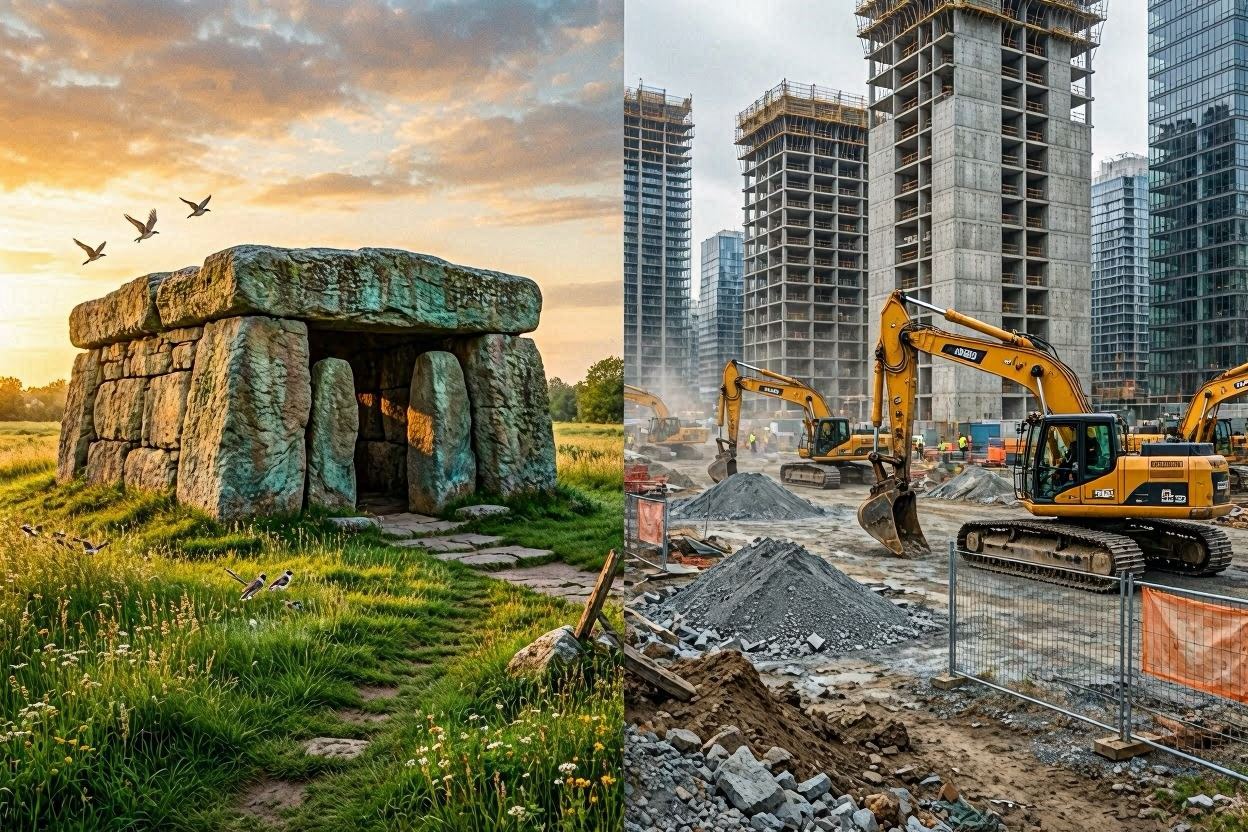
While South Korea’s 'Legoland/Gusandong crisis' and Mexico’s 'Tren Maya' differ in scale and circumstance, from an archaeological perspective, they share strikingly similar underlying issues.
| Category | South Korea (Chuncheon/Gimhae) | Mexico (Tren Maya) |
| Core Conflict | Local economy (tourism) & admin convenience vs. Preservation of original sites | State-led logistics/tourism infrastructure vs. Maya ruins & ecosystem protection |
| Cause of Destruction | Ignorance of local authorities, poor follow-up on conditional development | Rushed state power prioritizing speed, ignoring ecological/historical context |
| Common Excuse | "We will safely move the artifacts to a different location for display." | "We are relocating structures with millimeter precision." |
In both cases, developers argue, "We moved the artifacts safely, so there is no problem." But in archaeology, an artifact's value lies in its Context—the specific soil, location, and surrounding strata where it was found. A dolmen stripped from its burial ground or a Mayan altar disassembled and reassembled in a park loses its historical lifeblood.
4. Conclusion : Finding a Path Beyond the Concrete
Economic development and infrastructure expansion are unavoidable tasks in modern society. However, the perception that archaeological sites are mere 'annoying obstacles' to development must change.
The future of archaeology should move toward 'Public Archaeology,' embracing excavated sites as part of urban planning rather than locking artifacts inside museum glass cases. We should look to examples like the UK, where Roman city walls are naturally preserved in the modern lobbies of office buildings, or Germany, where active excavation sites are opened to the public as educational tourism resources.
A future built by erasing the past is nothing but a castle made of sand. We must heed the powerful warnings sent by the neglected dolmens in Chuncheon and the pierced cenotes in Mexico.
That’s all for the first story from Rocwing's History Archive. In the clash between heritage preservation and modern development, which values do you think should take priority? I will be back with more fascinating and sharp historical insights in the next post!