Imagine being a sovereign not just of a small kingdom, but of an expanding ancient empire akin to the Rome of Northeast Asia. Now, imagine watching your capital city burn to ashes, your mother dragged away in chains, and your father’s grave violently desecrated by invaders. This is not the plot of a dark fantasy epic—it is the very real, harrowing history of King Gogugwon, the 16th monarch of the ancient Korean kingdom of Goguryeo.
While history often remembers only the victors and the golden ages, the story of Goguryeo’s rise to become the supreme powerhouse of East Asia is soaked in the blood and tears of a forgotten king who bore the ultimate weight of a crumbling world. Today, we unearth the tragic saga of a ruler who stood as a human shield for his empire during its darkest hour.
1. The Foundation of an Empire : The Shadow of King Gogukcheon
To truly understand the tragedy of King Gogugwon, we must look back a century and a half to the 9th ruler, King Gogukcheon (r. 179–197 CE), who laid the very foundation of the Goguryeo Empire.
Early Goguryeo was a loose confederation of five distinct tribes. King Gogukcheon brilliantly centralized this power, transforming tribal territories into administrative districts under strict royal control. But his most shining achievement was the unprecedented "Jindae Law"—an ancient national welfare system that loaned grain to starving farmers in the spring to be repaid in the autumn harvest. By stabilizing the lives of the common people, he secured the economic and military manpower needed to build a colossal state.
King Gogukcheon built the empire's invincible armor; a century later, King Gogugwon would have to wear it against a storm of blades.
2. The 4th Century Crisis : A Target on Goguryeo's Back
By the time King Gogugwon ascended the throne in 331 CE, the geopolitical landscape of East Asia was a volatile powder keg. His grandfather, King Micheon, had aggressively expanded Goguryeo’s borders, driving out Chinese commanderies. But this massive expansion came with a deadly price: Goguryeo now shared direct borders with terrifying new superpowers.
The most dangerous of these was Former Yan, a rising nomadic empire established by the Murong clan of the Xianbei people. Aiming to conquer the Chinese mainland, Former Yan knew they could not march south with the formidable Goguryeo army breathing down their necks. A devastating clash was inevitable.
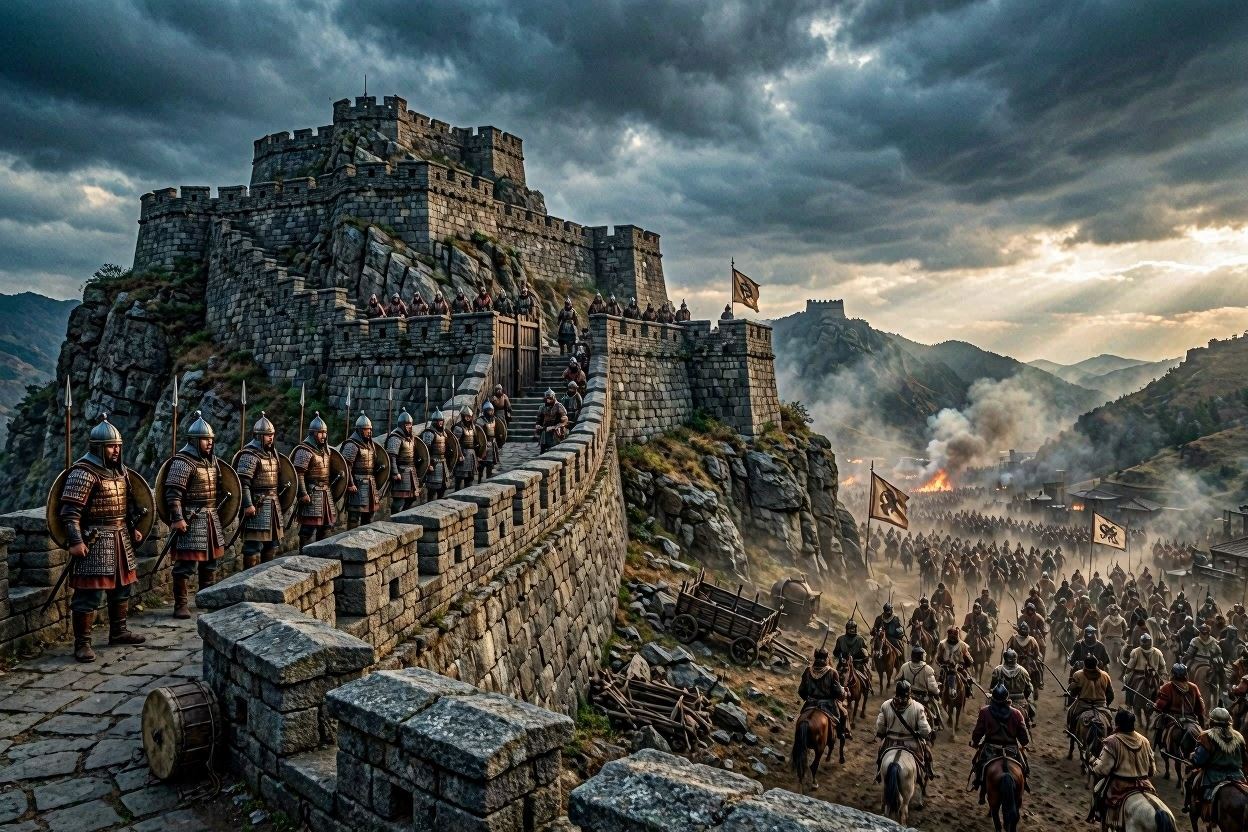
3. The Fall of Hwando Fortress: A Strategy Deceived
In 342 CE, Murong Huang, the ruler of Former Yan, launched a massive invasion into Goguryeo. The route to the Goguryeo capital, Hwando Mountain Fortress, split into two paths: a treacherous, narrow southern mountain pass and a wide, flat northern road.
Anticipating that the enemy cavalry would take the easier northern route, King Gogugwon dispatched his elite force of 50,000 soldiers to the north, while he personally guarded the treacherous southern pass with a small contingent. It was a fatal miscalculation. Murong Huang sent his main force of 40,000 elite troops straight through the rugged southern mountains, completely ambushing the King.
King Gogugwon’s forces were decimated. Hwando Fortress, the proud heart of the empire, was brutally sacked.
4. The Ultimate Humiliation and the Archaeological Truth
The atrocities committed by the Former Yan army were cataclysmic. They took 50,000 Goguryeo citizens as prisoners of war, including King Gogugwon’s own mother (the Queen Dowager) and his wife. Most horrifying of all, to utterly break the spirit of Goguryeo, the invaders dug up the tomb of the previous king, King Micheon, and carted his corpse away as a hostage. It was an apocalyptic humiliation.
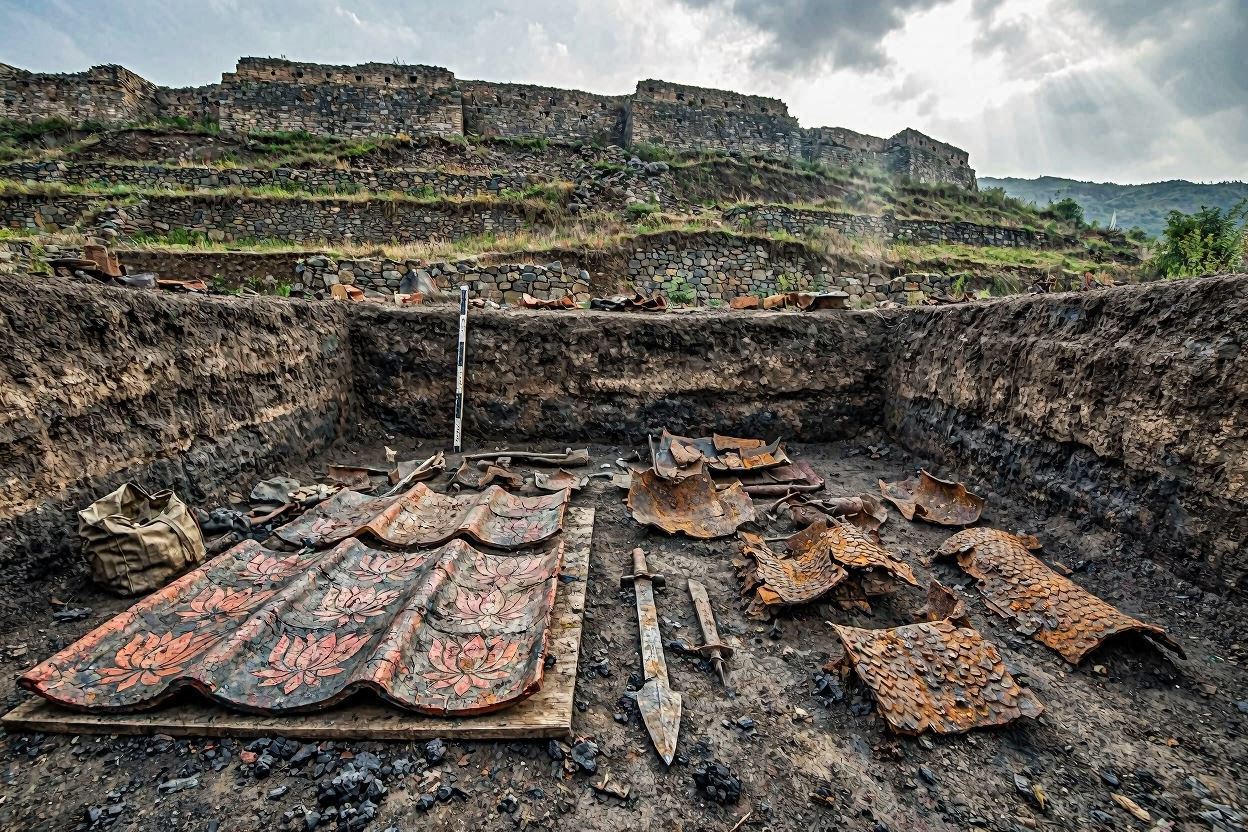
Modern archaeology has vividly confirmed this historical trauma. Excavations at the Hwando Fortress site (in modern-day Ji'an, China) have uncovered layers of dark, scorched earth surrounding the palace grounds. Amidst the ashes, archaeologists found beautifully crafted red lotus roof tiles that had been heavily burned, alongside rusted iron armor fragments and broken weaponry. The earth itself still bears the scars of Goguryeo's darkest day.
5. The Final Stand: A King Falls in Battle
To retrieve his father’s corpse and secure the release of his mother, the devastated King Gogugwon had to swallow his pride, declaring himself a vassal and sending tribute to Former Yan. Desperate to restore his empire's shattered prestige, the aging warrior-king turned his eyes south, toward the Kingdom of Baekje.
Unfortunately, Baekje was undergoing its own golden age under the legendary King Geunchogo. In 371 CE, King Geunchogo led 30,000 elite troops in a surprise attack on Goguryeo’s southern stronghold, Pyongyang Castle.
King Gogugwon, who had spent his entire life weathering the storms of war, did not hide behind his palace walls. He personally led his army to defend the city. However, in the chaotic fog of war, a stray arrow (known as a "blind arrow") struck the king, mortally wounding him. He died on the battlefield in October of that year—becoming the first and only monarch in ancient Korean history to be killed in action by enemy forces.
6. Epilogue : The Blood That Fertilized an Empire
On the surface, King Gogugwon’s life reads like a tragic series of failures. His capital was destroyed, his ancestors desecrated, and his life ended by an enemy arrow.
Yet, his agonizing sacrifices were not in vain. Witnessing the horrors inflicted upon his father and his nation, his son, King Sosurim, initiated radical and ruthless internal reforms. He adopted Buddhism to unite the people, established a national academy to train brilliant scholars, and promulgated a strict code of law.
If King Gogugwon had not stood as a bleeding human shield to absorb the devastating blows of foreign invasions, King Sosurim’s monumental reforms—and the subsequent invincible Golden Age led by Gwanggaeto the Great—would never have been possible.
Sometimes, the foundation of an empire is not built on golden victories, but on the silent, agonizing resilience of a king who refused to surrender to the dark.